2D vs 3D Projection Mapping: What Is the Difference?
Projection mapping can transform ordinary surfaces into engaging visual experiences using digital content and specialised projectors. However, not every projection mapping installation creates the same visual effect. Some projects focus on displaying graphics and animations across physical surfaces, while others create the illusion that buildings and objects are changing shape or revealing hidden dimensions.
This is where the difference between 2D and 3D projection mapping becomes important.
Understanding 2D vs 3D projection mapping can help you choose the right approach for your event, museum, product launch, architectural display, or immersive installation.
In this guide, we explain how both techniques work, their key differences, their applications, and the factors to consider when selecting the right projection mapping solution.
What Is 2D Projection Mapping?
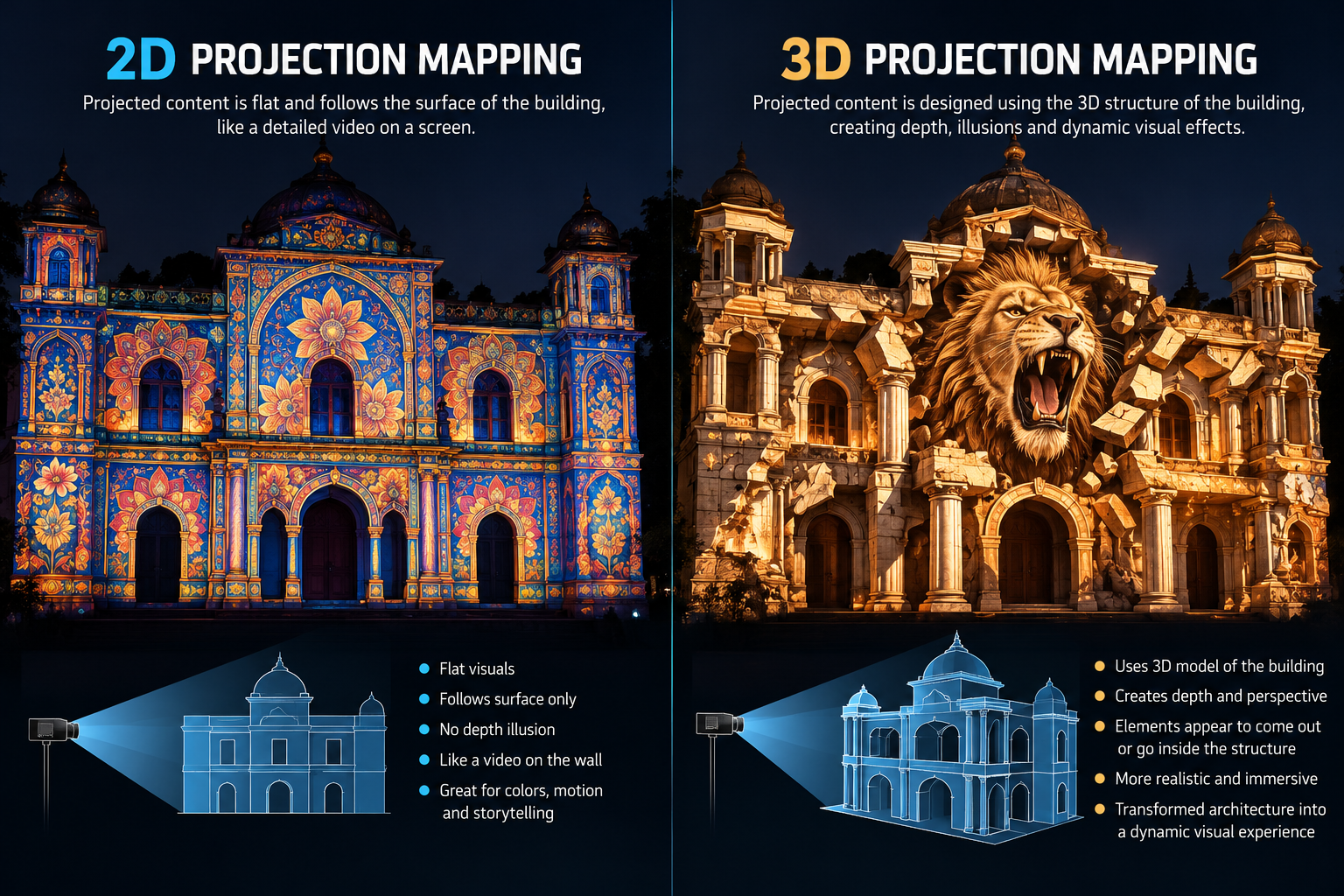
2D projection mapping uses flat graphics, images, videos, and motion graphics that are aligned with a physical surface.
The content is designed to fit the shape and dimensions of the target area. Although the visuals are two-dimensional, they can still interact with architectural features such as windows, columns, walls, and display structures.
For example, a building façade can display animated patterns, moving graphics, historical images, or visual storytelling sequences that follow the building’s architectural layout.
The aim is to make the content work naturally with the physical surface.
How Does 2D Projection Mapping Work?
The process begins with measuring the target surface and understanding its dimensions.
The creative team then develops suitable graphics or animation and uses projection mapping software to align the content with the surface.
The projected image is adjusted through techniques such as warping and masking so that the visuals appear in the intended locations.
Depending on the project, a single projector may be sufficient, although larger surfaces can require multiple projectors.
Where Is 2D Projection Mapping Used?
2D projection mapping is suitable for a variety of applications, including:
Corporate presentations and events
Museum information displays
Retail environments
Exhibition graphics
Architectural visual displays
Promotional presentations
Educational installations
It can be a practical choice when the goal is to communicate information, display graphics, or create visually engaging content without extensive three-dimensional animation.
What Is 3D Projection Mapping?
3D projection mapping uses specially designed visuals to create the illusion of depth, movement, and transformation on physical surfaces.
The projected content may make a building appear to open, a sculpture seem to change shape, or a product reveal imaginary internal components.
These effects rely on carefully designed animation, perspective, surface geometry, and projector alignment.
Although the visuals may appear three-dimensional, the physical surface does not necessarily move or change. The effect is created through the interaction between the projected content and the real-world structure.
How Does 3D Projection Mapping Work?
The process begins with studying the geometry of the object or structure.
The creative team develops animation that uses the surface’s shape and features to create the intended illusion. The content is then mapped to the physical structure using specialised software.
Projector placement and viewing angles are particularly important because the illusion may look more convincing from specific audience positions.
For large installations, multiple projectors may be required to cover the surface. Their outputs must be aligned carefully to maintain a consistent image.
Where Is 3D Projection Mapping Used?
3D projection mapping is commonly used for:
Architectural projection mapping shows
Monument and heritage storytelling
Product launches
Stage productions
Museum installations
Brand experiences
Special events and public attractions
It is particularly effective when the objective is to create dramatic visual transformations or make a physical structure appear to change in unexpected ways.
2D vs 3D Projection Mapping: Key Differences
Although both techniques use projectors and digital content, they differ in their creative approach, production requirements, and visual effects.
| Feature | 2D Projection Mapping | 3D Projection Mapping |
|---|---|---|
| Content style | Flat graphics, images, video and motion graphics | Animation designed to create an illusion of depth and transformation |
| Visual effect | Displays content aligned with a physical surface | Makes surfaces appear to change shape, open, break or transform |
| Content production | Can be relatively straightforward, depending on complexity | Often requires more detailed animation, perspective planning and surface-specific design |
| Surface requirements | Works on flat or irregular surfaces with suitable mapping | Benefits from carefully analysed geometry and appropriately designed content |
| Technical setup | May use a simple or complex projector configuration | May require more detailed calibration and projector planning, depending on the effect |
| Typical applications | Information displays, graphics, presentations and exhibitions | Architectural shows, monuments, product reveals and dramatic visual experiences |
| Production budget | Can be lower for simpler projects | Can be higher when detailed 3D content and complex installation are required |
| Creative objective | Communicate information or present visual content | Create a stronger illusion of depth, movement or transformation |
Important: 3D projection mapping is not automatically more expensive than every 2D project. Actual costs depend on content complexity, surface size, equipment, installation requirements, and production time.
Which Creates a More Realistic Visual Experience?
The answer depends on the creative concept and how the content is designed.
2D projection mapping can produce impressive results when the graphics are aligned carefully with the surface. It works well for animations, visual storytelling, information displays, and graphic transitions.
3D projection mapping is particularly effective when the content is designed to interact with the physical object’s geometry.
For example, a building may appear to collapse, rebuild itself, or reveal a different structure behind its façade.
The illusion depends on factors such as perspective, projector placement, surface geometry, content quality, and the intended viewing position.
Neither technique guarantees a better result on its own. The most suitable approach is the one that supports the project’s objectives.
Which Is Better for Building Projection Mapping?
Both 2D and 3D projection mapping can be used on buildings.
The right technique depends on the type of experience you want to create.
Choose 2D Projection Mapping When:
You want to display graphics, images, or animated patterns.
The presentation focuses on information or storytelling.
The content needs to be updated frequently.
The creative concept does not require elaborate visual transformations.
Choose 3D Projection Mapping When:
You want the building to appear to change shape.
The show requires dramatic architectural illusions.
You want to create the appearance of depth or movement.
The content needs to interact closely with the building’s geometry.
For large architectural shows, a production may combine both approaches. Simple graphic sequences can introduce a story, while 3D animation creates the most dramatic moments.
This combination can provide variety without requiring every scene to use complex animation.
2D vs 3D Projection Mapping for Museums
Museums can benefit from both techniques, depending on the exhibits and learning objectives.
2D Projection Mapping in Museums
2D projection mapping can display historical photographs, maps, diagrams, timelines, and animated information.
It is useful when visitors need to understand specific details or follow a clear sequence of information.
3D Projection Mapping in Museums
3D projection mapping can help demonstrate how an object was constructed, illustrate changes over time, or create the illusion that a historical structure is being rebuilt.
It can also make models and display objects more engaging by using their shapes as part of the visual presentation.
Which Should a Museum Choose?
A museum should select the technique according to the story being communicated.
Information-heavy exhibits may benefit from clear graphics, while exhibits that explain structures, processes, or transformations may benefit from three-dimensional visual effects.
A well-planned museum experience can combine both approaches throughout the exhibition.
What Equipment Is Needed for 2D and 3D Projection Mapping?
Both techniques use similar core equipment, although the exact setup varies according to the project.
Projectors
Projectors display the visual content onto the physical surface. Brightness, resolution, lens selection, and throw distance must be considered.
Projection Mapping Software
Mapping software helps align the visuals with the target surface through warping, masking, and geometric correction.
Content Creation Software
2D projects may use graphic design, compositing, and motion graphics tools. Projects involving 3D mapping may also require 3D modelling, animation, lighting, and rendering workflows.
The tools used depend on the production pipeline rather than a fixed rule that every 3D project must use a particular application.
Media Servers and Playback Systems
Playback systems deliver the content to the projectors. Larger installations may require multiple video outputs and synchronisation.
Calibration and Installation Equipment
Accurate positioning and calibration help ensure that the content matches the physical surface.
The technical setup should be designed around the installation requirements, not simply the type of animation being used.
How Much Does 2D vs 3D Projection Mapping Cost?
There is no fixed price difference between 2D and 3D projection mapping.
A simple 2D installation may require less content production time than a detailed 3D architectural show. However, a complex 2D project involving multiple surfaces and extensive animation can also require substantial resources.
The main factors affecting cost include:
Surface dimensions and geometry
Number and specifications of projectors
Lens requirements and projector positions
Content creation and animation complexity
Mapping software and playback equipment
Installation and calibration
Audio, lighting and synchronisation
Project duration and technical support
For a realistic estimate, the production team needs information about the location, surface, creative concept, expected visual effects, and installation schedule.
A site survey and project brief help determine the appropriate technical approach and budget.
Can 2D and 3D Projection Mapping Be Used Together?
Yes. Combining 2D and 3D projection mapping can create a more varied and engaging visual experience.
For example, an architectural show might begin with animated graphics and historical photographs. The content could then transition into a three-dimensional illusion in which the building appears to open or transform.
Similarly, a museum installation might use 2D diagrams to explain a historical event and 3D animation to demonstrate how a structure was built.
Using both techniques allows the creative team to balance information, storytelling, and dramatic visual effects.
The key is to ensure that each technique serves a clear purpose within the overall experience.
How Visual GAP Approaches Projection Mapping
At Visual GAP, projection mapping combines visual storytelling, digital content creation, and technical planning.
The choice between 2D and 3D projection mapping depends on the surface, the intended audience experience, and the creative objectives.
For some projects, clear motion graphics and visual information may be the best approach. Others may benefit from detailed animation that uses the geometry of a building, monument, or exhibit to create a transformation effect.
Visual GAP works across architectural and monument mapping, museum projection, dome and 360° experiences, water projection, and immersive rooms.
Every project requires a tailored approach to content development, projector selection, mapping, and installation.
Planning a projection mapping project? Contact Visual GAP to discuss your concept and explore the right approach for your space.
Frequently Asked Questions
1. What is the main difference between 2D and 3D projection mapping?
2D projection mapping typically uses graphics, video, and motion graphics aligned with a surface. 3D projection mapping uses specially designed visuals and perspective to create the illusion of depth, movement, or structural transformation.
2. Is 3D projection mapping better than 2D projection mapping?
Not always. The best option depends on the creative objectives, available budget, surface geometry, and intended audience experience. Some projects benefit more from clear 2D visuals, while others require three-dimensional illusions.
3. Does 3D projection mapping require special projectors?
Not necessarily. Both techniques can use similar projector technology. The projector specifications and lens requirements depend on the surface, viewing environment, image quality, and installation design.
4. Can 2D projection mapping be used on buildings?
Yes. 2D projection mapping can display animations, graphics, images, and video across building façades. The content must be aligned with the architecture for the best results.
5. Is 3D projection mapping suitable for museums?
Yes. It can help museums illustrate historical reconstructions, demonstrate how objects work, and create visual effects that make exhibits more engaging.
6. Can both techniques be used in one show?
Yes. Combining 2D graphics with 3D visual effects can create a varied presentation that balances information, storytelling, and dramatic moments.
7. Which technique is more expensive?
Neither technique is always more expensive. Costs depend on content complexity, equipment, installation requirements, surface size, and production time.
8. What surfaces can be used for 3D projection mapping?
Buildings, monuments, sculptures, product models, exhibition structures, and other suitable surfaces can be used. The content and projector setup must be designed for the geometry and viewing conditions.
Conclusion
The main difference between 2D and 3D projection mapping lies in the visual approach and the experience the content is designed to create.
2D projection mapping is effective for graphics, information, and visual storytelling, while 3D projection mapping can create illusions of depth, movement, and architectural transformation.
Both techniques have valuable applications in museums, events, product presentations, and architectural displays.
In many projects, combining the two approaches offers the flexibility to communicate information and create memorable visual moments.
The right choice depends on the surface, creative objectives, technical requirements, and budget.
Explore projection mapping with Visual GAP to find a solution tailored to your next project.