Projection Mapping for Education and Universities: Transforming Learning Through Immersive Technology
Education is evolving beyond traditional classrooms, printed materials, and conventional presentation screens. Educational institutions are increasingly exploring digital technologies that help students visualise complex concepts, interact with information, and experience subjects in engaging new ways.
Projection mapping for education offers an innovative way to combine physical spaces with digital content. By projecting visuals onto walls, architectural structures, educational models, and specially designed surfaces, institutions can create immersive learning environments and memorable educational experiences.
From university events and campus installations to science museums and interactive exhibitions, projection mapping can help educators communicate ideas through visual storytelling.
What Is Projection Mapping in Education?
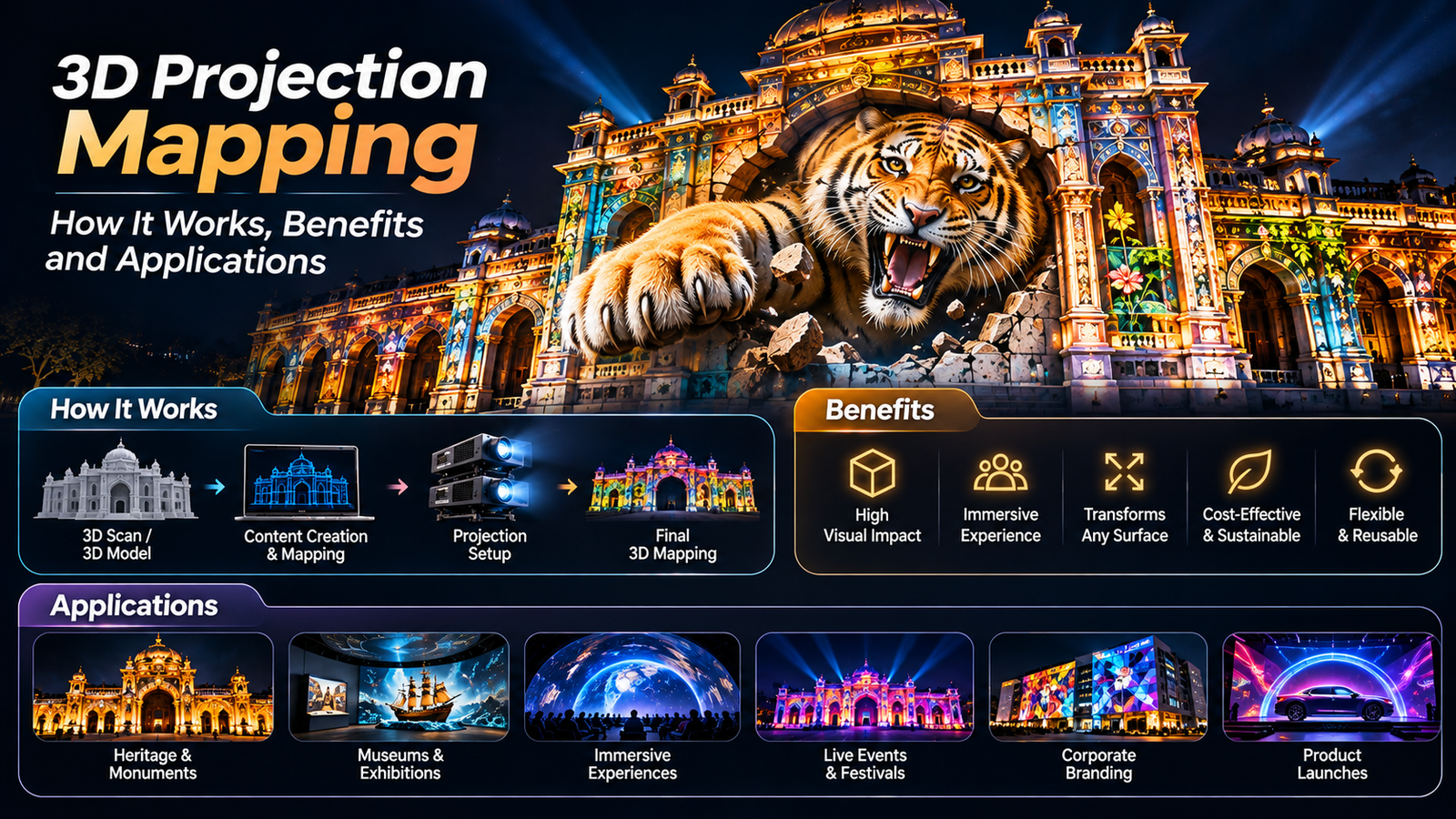
Projection mapping is a technology that uses specialised projectors to align digital images and animations with the shape of a physical surface.
Unlike conventional projection onto a flat screen, it allows visuals to interact with three-dimensional objects, architectural features, and specially designed educational installations.
In educational environments, projection mapping can be used for:
Interactive-looking educational exhibits
Science and technology demonstrations
University campus events
Historical and cultural storytelling
Architectural model presentations
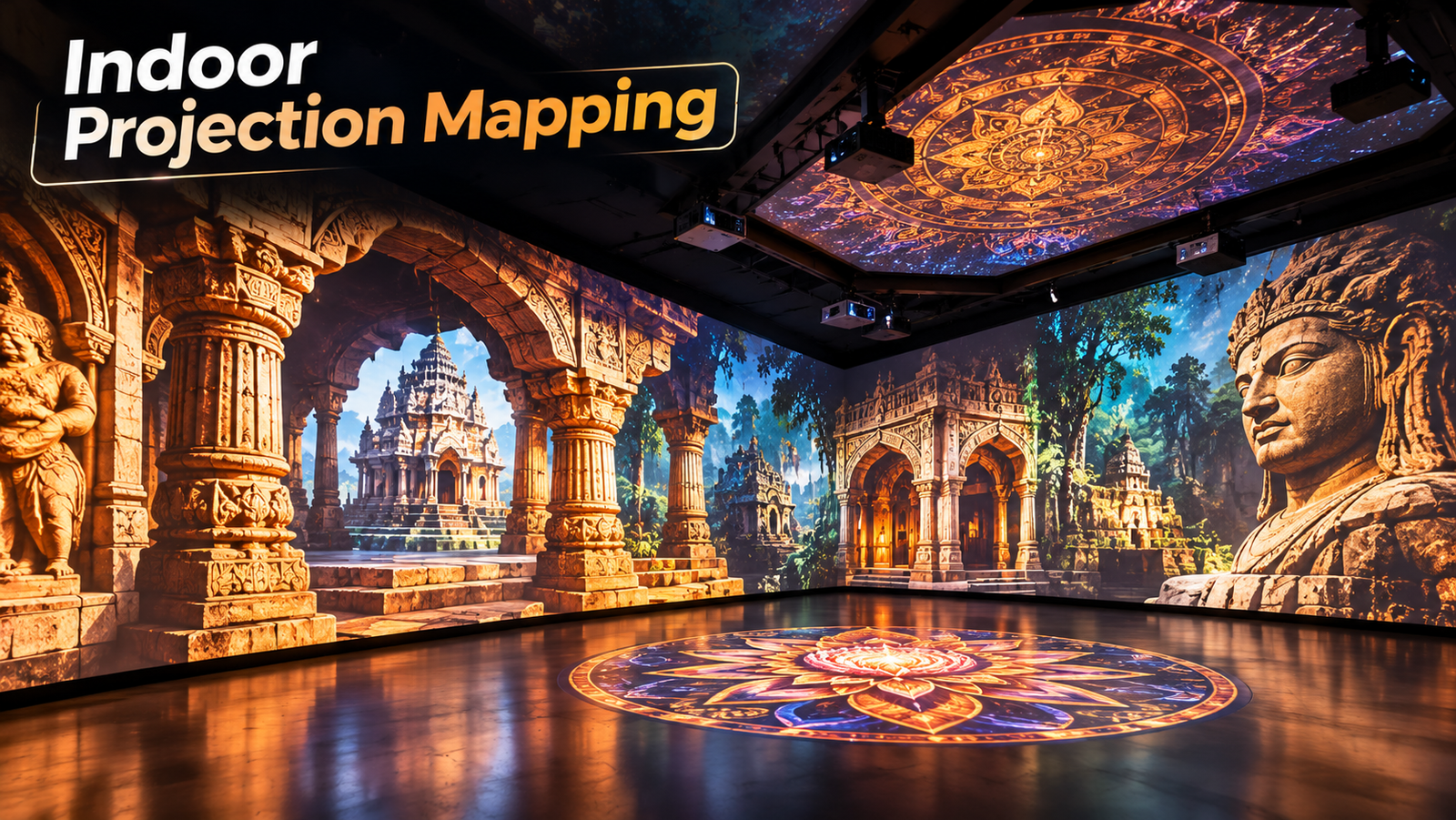
Immersive classrooms and learning spaces
Museum and research exhibitions
Graduation ceremonies and academic celebrations
The technology can help educators present information visually, particularly when a concept is difficult to explain through text alone.
Benefits of Projection Mapping for Educational Institutions
1. Making Complex Concepts Easier to Visualise
Some educational subjects involve processes and structures that are difficult to observe directly.
Projection mapping can help illustrate these concepts through animated visual explanations.
For example, a science exhibition could use a three-dimensional model to demonstrate the layers of the Earth, the movement of tectonic plates, or the structure of a scientific system.
Similarly, an engineering exhibition could present a model with animated overlays highlighting individual components.
These visualisations can support explanation and discussion, although their educational value depends on the accuracy of the content and how effectively it is integrated into the lesson.
2. Creating Immersive Learning Environments
Projection mapping can transform selected classrooms, exhibition areas, and learning spaces into immersive visual environments.
Instead of presenting every topic on a conventional screen, educators can use the surrounding space to create a themed visual experience.
A lesson about the solar system, for instance, might include projected celestial imagery across suitable walls and surfaces. A geography session could use large-scale visual content to explore landscapes, climate systems, or geographical features.
Such environments can make lessons more engaging when the visuals support clearly defined learning objectives.
3. Enhancing University Events and Campus Experiences
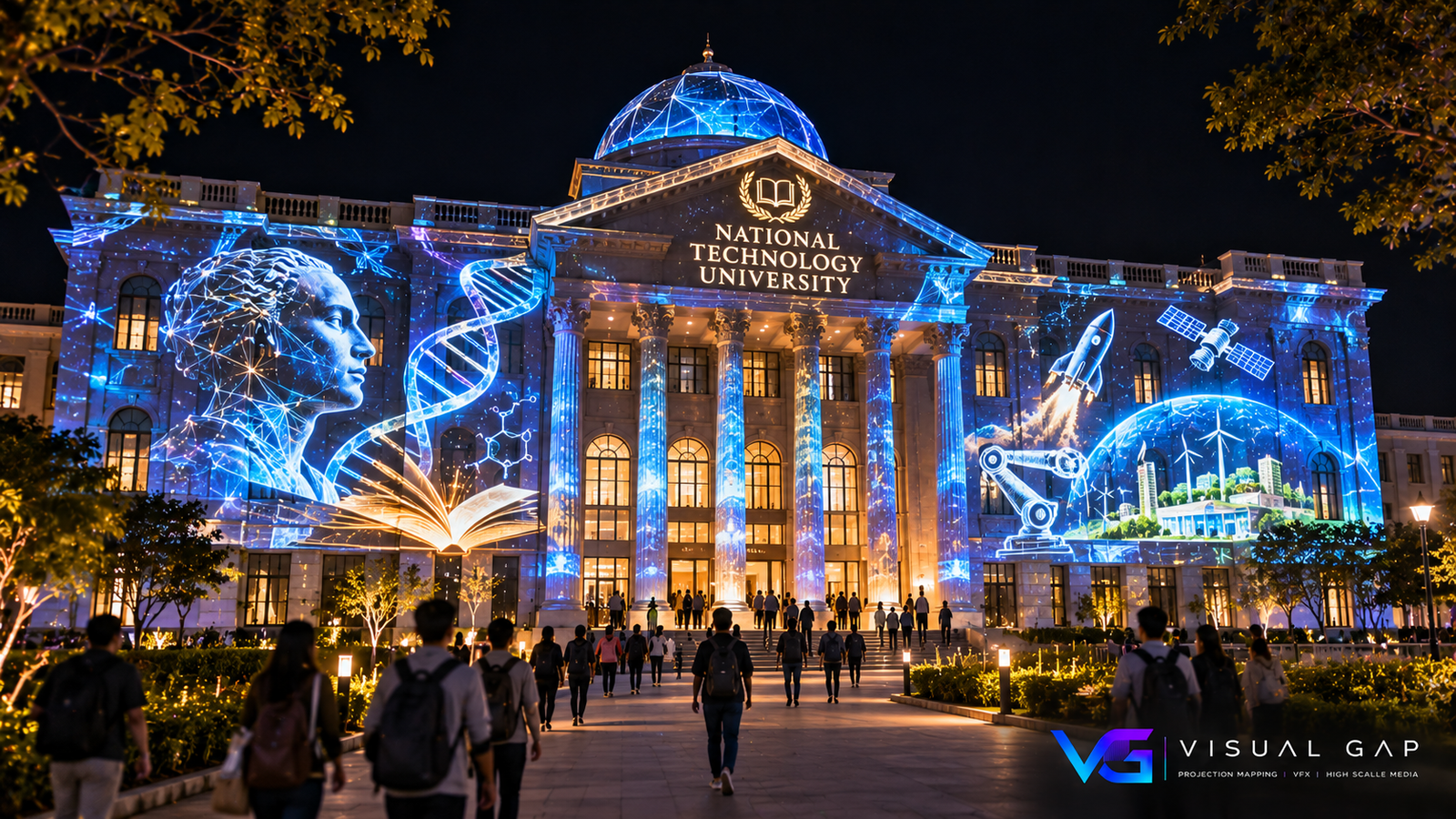
Universities host conferences, cultural festivals, graduation ceremonies, research showcases, and institutional celebrations.
Projection mapping can transform campus buildings, auditoriums, and event stages into distinctive visual environments.
Possible applications include:
University anniversary celebrations
Graduation ceremonies
Academic conferences
Cultural festivals
Research presentations
Student exhibitions
Campus branding events
For outdoor campus installations, teams should assess the building’s geometry, ambient light, projector positions, permissions, and visitor safety.
Explore our guide to Outdoor Projection Mapping to learn more about projecting onto exterior surfaces.
4. Supporting Museum and Heritage Education
Museums and heritage institutions use visual storytelling to help visitors understand history, culture, science, and technology.
Projection mapping can add digital interpretation to selected exhibits, architectural models, historical reconstructions, and immersive exhibition spaces.
For example, a historical exhibition might use projected animation to explain how an ancient settlement developed over time. A science museum could use a mapped model to demonstrate the functioning of a mechanical system.
These applications can complement physical artefacts and interpretive displays without replacing the underlying educational material.
When working with heritage objects or protected buildings, installations must follow relevant conservation requirements and permissions.
5. Encouraging Visual Exploration
Projection mapping can create opportunities for students to explore a subject from different visual perspectives.
A mapped architectural model could highlight individual building components. A geological exhibit could illustrate the formation of different rock layers. An astronomy installation could visualise planetary movement.
When combined with guided activities, questions, and discussion, these experiences may support curiosity and help students connect abstract information with physical representations.
However, projection mapping alone does not guarantee better learning outcomes. Content quality, accessibility, teaching methods, and opportunities for active participation remain important.
Applications of Projection Mapping in Education
Different educational institutions can use the technology in different ways.
| Application | Example |
|---|---|
| Schools | Visual demonstrations of scientific and geographical concepts |
| Universities | Campus events, research showcases, and academic presentations |
| Science museums | Animated exhibits and scientific visualisations |
| History museums | Historical storytelling and architectural reconstructions |
| Engineering institutions | Mapped physical models and component demonstrations |
| Architecture schools | Architectural model presentations |
| Cultural institutions | Immersive storytelling about art and heritage |
| Educational exhibitions | Specialised visual installations for public engagement |
The most suitable application depends on the audience, subject, available space, educational goals, and budget.
Projection Mapping for Science and Technology Exhibitions
Science and technology exhibitions often rely on physical models, demonstrations, and explanatory graphics.
Projection mapping can add another visual layer by aligning animation with the shape of an exhibit.
A model of a machine, for example, could display different components in sequence. A geological model might illustrate underground structures, while an environmental exhibit could show the movement of water through an ecosystem.
The content should be designed around the physical exhibit and the learning objective.
For technical subjects, educators and subject specialists should review the animation to ensure that it communicates the correct information without introducing misleading visual simplifications.
How to Plan a Projection Mapping Project for Education
A successful educational installation combines instructional planning, creative development, and technical execution.
Step 1: Define the Learning Objective
Begin by identifying what students or visitors should understand after experiencing the installation.
The objective might involve explaining a scientific process, introducing a historical period, presenting an engineering concept, or creating an engaging university event.
A clearly defined objective helps determine the appropriate content and format.
Step 2: Select the Surface or Exhibit
Choose a suitable projection surface, such as a wall, architectural model, physical exhibit, or purpose-built structure.
Assess its dimensions, colour, texture, geometry, and location. Consider the distance from which the audience will view the experience.
Step 3: Develop the Educational Story
Organise the information into a logical sequence.
For example, a scientific presentation could introduce a problem, demonstrate the process, highlight the important components, and summarise the outcome.
Avoid overloading the experience with unnecessary effects. Visual elements should support the subject rather than distract from it.
Step 4: Design the Technical System
The technical team evaluates projector specifications, lens selection, placement, resolution, image coverage, playback equipment, and available power.
The configuration depends on the surface, lighting conditions, audience size, and required visual quality.
Step 5: Produce and Map the Content
The creative team develops animations and graphics according to the physical surface.
For three-dimensional exhibits, the content must be aligned with the geometry of the object. This may require detailed mapping, calibration, and on-site adjustments.
Step 6: Test with the Intended Audience in Mind
Test the installation for visibility, readability, timing, and playback reliability.
Consider audience height, viewing angles, room lighting, accessibility, and whether the content can be understood without specialist knowledge.
Where appropriate, educators can review the content before public use.
How Much Does Projection Mapping for Education Cost?
The cost of an educational projection mapping installation depends on the scale of the project, the complexity of the content, and the technical equipment required.
Key cost factors include:
Size and geometry of the projection surface
Number and specifications of projectors
Custom animation and educational content
Mapping and calibration requirements
Media servers and playback systems
Installation and mounting arrangements
Audio and control equipment
Site surveys and testing
Technical support and maintenance
A temporary installation for a university event may have different requirements from a permanent educational exhibit or an immersive learning environment.
For a more detailed explanation of pricing factors, read our Projection Mapping Costs guide.
Challenges to Consider
Before implementing projection mapping in an educational environment, institutions should assess several practical considerations.
Content accuracy: Scientific, historical, and technical material must be reviewed by appropriate subject specialists.
Ambient lighting: Bright classrooms and exhibition areas may reduce image contrast.
Accessibility: Visual content should consider different viewing positions and the needs of diverse learners.
Technical reliability: Playback and equipment should be tested before teaching sessions or public events.
Operational requirements: Permanent installations need maintenance, content updates, and staff training.
Budget constraints: Institutions should consider the full cost of equipment, content production, installation, and ongoing support.
Educational effectiveness: The technology should support a defined learning objective rather than being used only for visual spectacle.
Is Projection Mapping Worthwhile for Educational Institutions?
Projection mapping may be valuable for institutions that want to present complex information visually, create distinctive exhibitions, or develop immersive educational experiences.
Its effectiveness depends on the relevance of the content, the quality of the instructional design, the needs of the audience, and the reliability of the technical system.
Before investing, institutions should identify the intended learning outcomes and compare projection mapping with alternatives such as conventional displays, interactive screens, physical models, and digital simulations.
The best solution is the one that serves the educational purpose within the available resources.
Conclusion
Projection mapping for education offers new ways to combine digital storytelling, physical exhibits, and immersive visual communication.
From science demonstrations and historical exhibitions to university celebrations and architectural model presentations, it can help institutions create engaging experiences tailored to their audiences.
The most effective installations combine accurate educational content, purposeful visual design, suitable projection equipment, and careful technical planning.
Visual GAP develops projection mapping and immersive visual experiences for architectural spaces, museums, exhibitions, events, and public attractions. Each project is designed around the location, the subject, and the experience the audience should take away.