Projection Mapping for Science Museums: Making Science Interactive and Immersive
Science museums are evolving beyond traditional displays, static models, and information panels. Today, visitors expect engaging experiences that help them understand complex scientific concepts through visuals, interaction, and storytelling. Projection mapping for science museums offers an innovative way to transform ordinary exhibits into immersive learning environments.
From exploring the solar system to understanding the human body, geological formations, and scientific discoveries, projection mapping can make abstract concepts easier to visualize and remember.
For science museums, planetariums, educational centres, and interactive science galleries, immersive projection technology creates opportunities to combine education with entertainment.
What Is Projection Mapping in Science Museums?
Projection mapping is a visual technology that uses projectors to display digital content onto physical surfaces. Unlike conventional projection onto a flat screen, projection mapping can adapt visuals to the shape, dimensions, and geometry of objects, architectural features, and specially designed exhibits.
In a science museum, this technology can transform a physical model of a planet into a rotating globe, illustrate the internal structure of a volcano, or demonstrate how the human heart functions.
By aligning digital content with real-world objects, museums can create educational experiences that connect scientific information with visual understanding.
Learn more about the fundamentals in Visual GAP’s Complete Projection Mapping Guide.
1. Making Complex Scientific Concepts Easier to Understand
Many scientific concepts are difficult to explain through text or static images alone. Visitors may struggle to imagine processes that happen at microscopic scales, inside the human body, or across millions of years.
Projection mapping helps make these concepts visible.
For example, a science museum could use immersive visuals to demonstrate:
How blood circulates through the human body.
How tectonic plates move beneath the Earth’s surface.
How a volcano forms and erupts.
How cells divide and develop.
How electricity travels through a circuit.
How planets orbit the Sun.
How climate systems influence the Earth’s environment.
By visualizing these processes on physical models or immersive surfaces, museums can make complicated information more accessible to visitors of different ages.
2. Immersive Solar System and Space Exhibitions
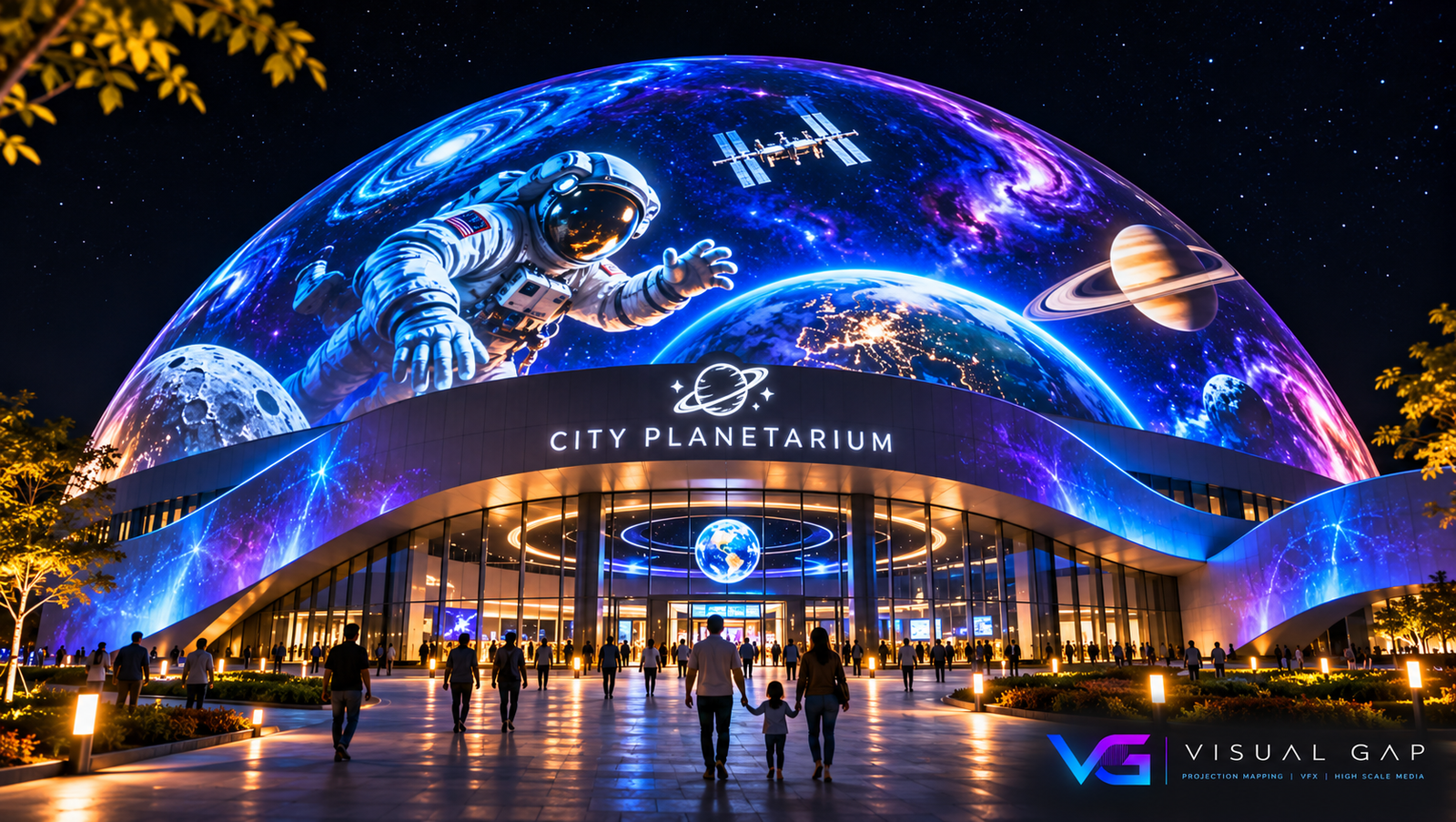
Space science is one of the most visually engaging subjects for museum visitors. Projection mapping can transform a spherical structure, room, or specially designed exhibit into an immersive space exploration experience.
Visitors could experience the planets, explore distant galaxies, observe the life cycle of stars, or travel through a simulated solar system.
A projection-mapped planetary model can display changing planetary surfaces, atmospheric conditions, orbital movements, and other educational visualizations.
For larger installations, immersive environments can surround visitors with astronomical imagery and synchronized sound, creating a stronger sense of scale and perspective.
These experiences can complement traditional planetarium content and provide additional ways to communicate astronomy and space science.
3. Projection Mapping on Interactive Science Models
Physical models remain valuable educational tools because visitors can see the size, shape, and structure of scientific objects. Projection mapping can enhance these models by adding dynamic digital information.
Potential applications include:
Human anatomy models: Display organs, blood flow, muscles, and internal systems through animated projections.
Mechanical models: Show how engines, gears, turbines, and industrial machines operate internally.
Earth models: Visualize weather patterns, ocean currents, climate zones, and geological changes.
Scientific equipment: Explain the functions of individual components through synchronized labels, animations, and visual demonstrations.
This approach combines the physical presence of an exhibit with the explanatory power of digital media.
The result is an exhibit that can communicate multiple layers of information without requiring a separate physical model for every concept.
4. Immersive Science Rooms and Projection Environments
Some scientific topics are best understood through a larger environment rather than an individual exhibit.
An immersive science room can use multiple projectors to cover walls, floors, ceilings, or custom-shaped surfaces. Carefully synchronized visuals create a continuous environment in which visitors can explore scientific subjects from different perspectives.
Examples include:
Walking through a simulated rainforest ecosystem.
Exploring the layers of the Earth’s atmosphere.
Experiencing the movement of ocean currents.
Understanding the water cycle through surrounding visuals.
Exploring the structure of a galaxy.
Observing environmental changes over time.
A well-designed immersive room can support group learning, guided presentations, school visits, and educational workshops.
For projects involving large architectural surfaces, outdoor projection mapping demonstrates how projection technology can also transform physical environments beyond conventional display screens.
5. Interactive Learning Through Projection Mapping
Interactive projection mapping allows visitors to influence the content they see. Instead of simply watching an animation, they can participate in an educational activity.
Depending on the project requirements, interaction can be implemented through touchscreens, motion tracking, sensors, computer vision, or other interactive systems.
For example, visitors might:
Move digital planets within a projected solar system.
Trigger animations by approaching a physical exhibit.
Explore the layers of a geological model.
Interact with a projected ecosystem.
Select scientific topics to reveal additional information.
Participate in collaborative problem-solving activities.
Interactive exhibits can encourage curiosity and exploration, particularly among younger visitors.
However, interaction should serve a clear educational purpose. An exhibit that looks impressive but lacks meaningful learning objectives may entertain visitors without helping them understand the underlying science.
6. Projection Mapping for STEM Education
Science, technology, engineering, and mathematics education often involves processes that are difficult to demonstrate physically.
Projection mapping can support STEM learning by combining visual explanation with physical exhibits and guided activities.
For example, an engineering gallery could show the forces acting on a bridge structure. A mathematics exhibit could visualize geometric transformations on three-dimensional objects. A physics installation could demonstrate waves, motion, gravity, or electromagnetic fields.
The content can be designed for different levels of understanding, allowing the same installation to support younger students, older learners, and general visitors.
Museums can also integrate projected content with demonstrations led by educators, making the technology part of a broader learning experience rather than a standalone attraction.
7. Designing Effective Projection-Mapped Science Exhibits
Successful science museum installations require more than powerful projectors and attractive animation. The technology, content, exhibit design, and educational objectives must work together.
Define the Learning Objective
Begin by identifying what visitors should understand after experiencing the exhibit. This helps determine the appropriate visuals, narrative, duration, and level of detail.
Select the Right Projection Surface
The surface could be a physical model, a sculptural installation, a curved structure, or an entire room. Its size, material, shape, and viewing distance influence the projection design.
Plan Brightness and Ambient Lighting
Museum lighting conditions affect image visibility and contrast. Projector brightness should be selected according to the projection area, surface characteristics, and surrounding light.
Create Scientifically Accurate Content
Scientific visuals should be engaging without sacrificing accuracy. Subject-matter experts and educators can help validate the information presented.
Consider Visitor Flow
The exhibit should allow visitors to approach, observe, and understand the content comfortably. Viewing angles, accessibility, crowd movement, and the number of simultaneous visitors all influence the design.
Design for Reliability and Maintenance
Museums often operate for long hours and host large numbers of visitors. Projector access, equipment ventilation, calibration, content playback, and maintenance procedures should be considered during planning.
8. How Much Does Projection Mapping for Science Museums Cost?
The cost of a science museum projection mapping installation depends on its scale, technical complexity, and content requirements.
A small installation using one projector and a simple physical model will generally require a different budget from a multi-projector immersive room with interactive tracking and custom-built exhibits.
Major cost factors include:
Number and brightness of projectors.
Projection surface dimensions and geometry.
Content design, animation, and scientific visualization.
Projection mapping and calibration software.
Interactive sensors and control systems.
Media servers, networking, and audio equipment.
Installation, testing, and commissioning.
Maintenance and future content updates.
For an accurate estimate, museum teams should prepare an initial brief covering the exhibit concept, available space, visitor capacity, desired interaction, content duration, and operating requirements.
Read Visual GAP’s guide to Projection Mapping Costs for a broader understanding of the factors that influence project budgets.
9. Why Science Museums Should Consider Projection Mapping
Projection mapping can help science museums present information in ways that are visually engaging, adaptable, and easier to explore.
Its key benefits include:
Visualizing invisible processes: Demonstrate scientific phenomena that cannot be observed directly.
Improving exhibit flexibility: Update digital content without replacing the entire physical exhibit.
Supporting different learning styles: Combine visuals, sound, physical objects, and interaction.
Increasing visitor engagement: Encourage exploration through immersive and interactive experiences.
Creating memorable attractions: Develop distinctive exhibits that complement conventional displays.
Supporting multiple audiences: Adapt content for school groups, families, researchers, and general visitors.
The best results come when projection mapping is integrated into a well-planned educational experience, with clear objectives and reliable technology.
Conclusion
Projection mapping for science museums creates new opportunities to explain complex scientific ideas through immersive visuals, physical models, and interactive storytelling.
Whether the goal is to explore space, understand the human body, demonstrate engineering principles, or communicate environmental change, projection technology can turn scientific information into an engaging visitor experience.
For museums planning a new science gallery or upgrading existing exhibits, the first step is to identify the learning objectives and select a projection approach that supports them.
Visual GAP develops immersive visual experiences, projection mapping installations, and digital storytelling environments for museums, exhibitions, and public spaces. With the right combination of content, technology, and exhibit design, science museums can make learning more visual, accessible, and memorable.