Projection Mapping for Corporate Events: Creating Immersive Brand Experiences
Corporate events are evolving beyond traditional stages, presentation screens, and conventional lighting. Businesses increasingly seek innovative ways to present their brands, launch products, communicate ideas, and create memorable experiences for their audiences.
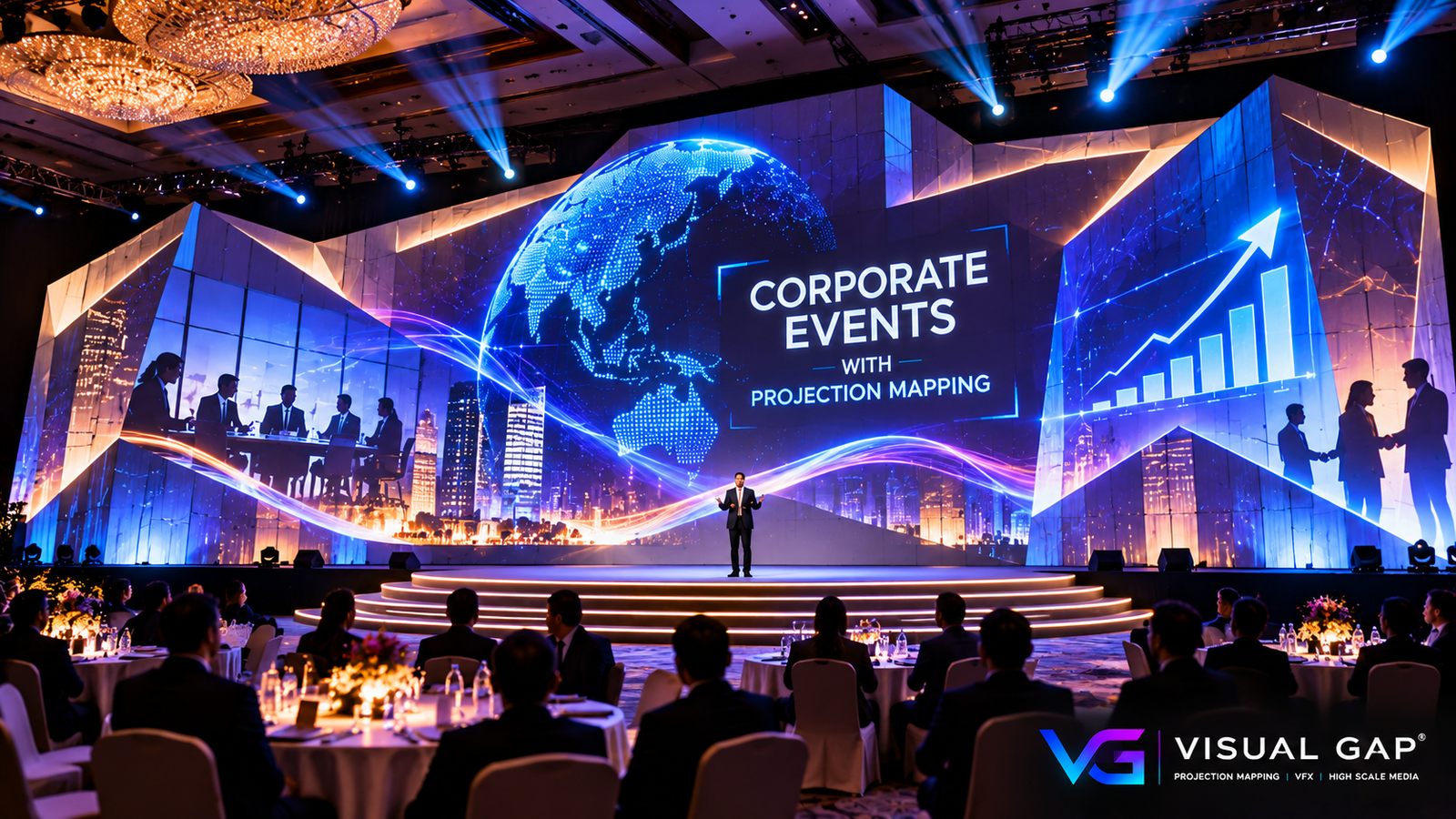
Projection mapping for corporate events transforms physical surfaces into dynamic visual displays using precisely aligned digital content. From dramatic product launches and immersive stage backdrops to interactive brand experiences, projection mapping helps companies communicate their messages in visually engaging ways.
Whether it is a corporate conference, annual celebration, investor event, brand activation, or product unveiling, projection mapping can turn an ordinary venue into a distinctive event environment.
For businesses looking to create a stronger visual impact, this technology offers a flexible alternative or complement to conventional event displays.
What Is Projection Mapping for Corporate Events?
Projection mapping is a visual technology that projects digital content onto physical surfaces, adapting the imagery to their shapes, dimensions, and geometry.
Unlike conventional projection onto a flat screen, projection mapping can transform stage structures, product models, architectural features, exhibition installations, and custom-built objects into dynamic visual displays.
For corporate events, the projected content can include animated graphics, branded visuals, product demonstrations, motion graphics, cinematic sequences, and three-dimensional visual illusions.
For example, a company launching a new automobile could project animations onto a physical vehicle model, revealing its design features through synchronized visuals. A technology conference could use a projection-mapped stage to create a dynamic environment that changes with each presentation.
The result is a visual experience designed around the event’s message and identity.
To understand the technology in greater detail, explore Visual GAP’s Complete Projection Mapping Guide.
1. Projection Mapping for Product Launches
Product launches are among the most suitable applications of projection mapping because they depend on anticipation, presentation, and visual storytelling.
Instead of revealing a product through a conventional presentation, brands can create a coordinated visual sequence that introduces its features, design, and capabilities.
Projection mapping can be used for launches involving:
Automobiles and electric vehicles.
Consumer electronics and smart devices.
Luxury products and premium merchandise.
Industrial machinery and engineering equipment.
New product collections.
Technology platforms and innovations.
A product launch could begin with animated graphics surrounding a covered object, gradually revealing its design before transitioning into feature demonstrations and brand messaging.
For physical products, the projection content must be carefully designed around the object’s shape, surface, and viewing angles. Reflective materials, complex geometry, and ambient lighting should be evaluated during technical planning.
When executed well, projection mapping can make a product unveiling more engaging while reinforcing the brand’s identity.
2. Projection Mapping for Corporate Stage Design
A corporate stage is often the visual centre of an event. Its design influences how audiences perceive the presentation, the speakers, and the brand itself.
Projection mapping allows stage designers to create visual environments that change throughout an event without rebuilding the physical stage for every segment.
Possible applications include:
Conference opening sequences: Create an energetic visual introduction that establishes the event theme.
Leadership presentations: Display motion graphics and supporting visuals that complement the speaker’s message.
Awards ceremonies: Build distinctive visual environments for award announcements and winner presentations.
Annual corporate celebrations: Use branded animations and cinematic content to support key moments.
Technology conferences: Create futuristic visual environments that communicate innovation.
Projection mapping can be applied to custom stage structures, sculptural elements, architectural features, or other suitable surfaces.
The content should always support the event rather than compete with speakers or essential information. Brightness, contrast, visual movement, and text placement need to be considered carefully.
3. Projection Mapping for Conferences and Business Summits
Conferences and business summits often include multiple sessions, speakers, presentations, and audience interactions. A well-designed projection system can help maintain a consistent visual identity throughout the programme.
Projection mapping can introduce each session with coordinated graphics, display event branding, and transform the stage atmosphere between different topics.
For example, a financial summit might use a projection-mapped stage to visualize economic trends, industry milestones, and key themes. A sustainability conference could use immersive visuals to illustrate environmental change and future-focused solutions.
Potential benefits include:
Consistent event branding.
Visually engaging session transitions.
Stronger presentation environments.
Support for keynote storytelling.
Flexible visual themes for different sessions.
A distinctive atmosphere for live audiences.
For conferences involving complex data, projections should prioritize readability. Important statistics, charts, and messages are usually better presented with clear layouts and limited visual distractions.
Projection mapping is most effective when the visual design complements the event’s communication goals.
4. Projection Mapping for Brand Activations
Brand activations aim to encourage audiences to engage directly with a brand, product, or campaign. Projection mapping can turn a physical installation into an attraction that invites visitors to stop, observe, and participate.
Brands can use projection mapping to create temporary experiences in shopping centres, exhibition halls, event venues, public spaces, and promotional installations.
Examples include:
Interactive branded installations.
Product demonstrations on physical models.
Immersive campaign environments.
Projection-mapped retail displays.
Experiential marketing installations.
Visual storytelling around a brand’s history.
Interactive elements can be added using sensors, motion tracking, touch interfaces, or other technologies, depending on the installation.
The campaign should have a clear purpose. Whether the goal is awareness, product education, audience participation, or lead generation, the visual experience should connect naturally to the brand message.
5. Projection Mapping for Corporate Galas and Award Ceremonies
Corporate galas and award ceremonies often require a premium atmosphere that reflects the importance of the occasion.
Projection mapping can transform suitable stage surfaces, architectural features, and event installations into coordinated visual environments.
A gala might feature elegant animated graphics, while an awards ceremony could use dynamic sequences to introduce categories, nominees, and winners.
For annual celebrations, companies can also create visual timelines showcasing important milestones, achievements, and future goals.
Projection mapping can be coordinated with lighting, audio, music, and stage management to support major moments in the programme.
However, these elements need to be synchronized carefully. Cue timing, content playback, audio transitions, and backup procedures should be tested before the event begins.
6. Projection Mapping vs LED Walls for Corporate Events
LED walls are widely used for conferences, presentations, and live events. Projection mapping provides a different set of creative possibilities.
The right choice depends on the event’s objectives, venue conditions, surface requirements, viewing distance, and budget.
| Feature | Projection Mapping | LED Wall |
|---|---|---|
| Display surface | Suitable physical surfaces and custom structures | Modular LED display panels |
| Creative possibilities | Can visually transform objects and architecture | Creates a configurable rectangular or shaped display |
| Daylight performance | Depends heavily on ambient light and projection conditions | Generally better suited to bright environments |
| Physical product integration | Can align visuals with suitable physical objects | Usually operates as a separate display behind or beside the product |
| Installation | Requires surface assessment, alignment, and calibration | Requires panel assembly, rigging, and system configuration |
| Content requirements | May require custom mapping and geometry-specific content | Often uses content prepared for the LED canvas |
| Best applications | Architectural transformation, object mapping, immersive visuals | Presentations, high-brightness displays, live video, and readable text |
Neither technology is universally better. In some corporate events, combining projection mapping with LED walls provides the best balance of visual impact, brightness, and information delivery.
For a more detailed comparison, read Visual GAP’s guide to Projection Mapping vs LED Wall.
7. How to Plan a Projection Mapping Experience for a Corporate Event
Successful projection mapping begins with planning. The creative concept, physical environment, content, and technical system must be developed together.
Define the Event Objective
Identify whether the installation will support a product launch, conference, brand activation, awards ceremony, or another event format.
The objective determines the visual style, narrative, and technical requirements.
Select the Projection Surface
The surface may be a stage structure, product model, architectural feature, or custom-built installation.
Measure its dimensions and assess its shape, colour, material, reflectivity, and available viewing angles.
Evaluate the Venue
Venue conditions influence projection brightness, contrast, projector placement, and audience visibility.
Consider ambient lighting, ceiling height, rigging positions, power availability, equipment access, and the distance between projectors and the target surface.
Develop the Content
The content should reflect the brand identity and event narrative. Depending on the project, it may include motion graphics, 3D animation, product visualizations, typography, or cinematic sequences.
If the content must align precisely with a physical object, production should use accurate measurements and a suitable mapping workflow.
Plan Technical Integration
Projection mapping may require projectors, media servers, playback systems, mapping software, cabling, audio synchronization, and control equipment.
For larger events, a technical rehearsal is essential to test content playback, calibration, synchronization, and cue transitions.
Prepare a Backup Plan
Live events operate under strict schedules. Teams should plan for equipment issues, playback interruptions, and last-minute programme changes.
Backup content, spare critical equipment, and clear responsibilities can help reduce operational risk.
8. How Much Does Corporate Event Projection Mapping Cost?
The cost of projection mapping for corporate events depends on the complexity of the installation and the level of creative production required.
A simple projection on a small stage element may have very different requirements from a multi-projector product launch featuring custom 3D animation and synchronized show control.
Major cost factors include:
Number and brightness of projectors.
Projection surface dimensions and complexity.
Custom content design and animation.
Mapping, calibration, and playback systems.
Media servers and control equipment.
Rigging, installation, and cabling.
Audio and lighting synchronization.
Technical rehearsals and on-site operation.
Event duration and equipment rental period.
Transport, accommodation, and logistics where applicable.
Content production is an important part of the budget. Custom animation designed for a specific stage or product generally requires more preparation than adapting existing content to a standard screen.
For a reliable quotation, share the event dates, venue details, surface measurements, programme requirements, content expectations, and technical specifications.
You can also explore Visual GAP’s guide to Projection Mapping Costs for an overview of the factors that influence project budgets.
9. Why Businesses Choose Projection Mapping for Corporate Events
Projection mapping can offer several advantages when it is planned around a clear event objective.
Distinctive visual presentation: Transform physical surfaces into branded visual environments.
Flexible creative design: Adapt the content to different event themes, products, and presentations.
Product-focused storytelling: Use physical objects and synchronized visuals to explain product features.
Brand consistency: Coordinate event graphics, stage visuals, and campaign messaging.
Immersive experiences: Create visual environments that go beyond conventional presentation screens.
Scalable concepts: Develop installations for different venue sizes and project requirements.
The effectiveness of projection mapping depends on the quality of the content, the suitability of the environment, and the technical execution. It should be selected because it serves the event’s purpose, not simply because it uses advanced technology.
Conclusion
Projection mapping for corporate events gives businesses new ways to present products, communicate brand messages, and create memorable live experiences.
From product launches and conferences to award ceremonies and immersive brand activations, projection mapping can transform suitable physical surfaces into dynamic visual environments.
Successful installations combine creative storytelling with careful technical planning, accurate measurements, reliable playback, and thorough rehearsals.
For businesses planning a corporate event, the best starting point is to define the audience experience, establish the key message, and select a projection approach that supports both.
Visual GAP develops projection mapping and immersive visual experiences for events, museums, exhibitions, architectural environments, and branded installations. By combining technical expertise with purposeful content design, Visual GAP helps transform event concepts into engaging visual experiences.