Projection Mapping for Automotive Launches: Creating Immersive Car Reveal Experiences
Automotive launches are designed to introduce new vehicles, showcase innovation, and create excitement around a brand. From luxury cars and electric vehicles to concept automobiles and next-generation mobility solutions, manufacturers invest heavily in presenting their products in memorable ways.
Projection mapping for automotive launches offers a creative way to transform vehicles, stages, and event environments into immersive visual experiences. By combining custom animation, architectural projection, synchronized lighting, and carefully planned storytelling, brands can reveal new vehicles in ways that go beyond conventional presentations.
Whether it is a luxury car unveiling, an electric vehicle launch, an automotive exhibition, or a dealer conference, projection mapping can help create a distinctive product reveal.
For automotive brands, event production companies, advertising agencies, and experiential marketing teams, this technology offers new possibilities for communicating design, performance, and innovation.
What Is Projection Mapping for Automotive Launches?
Projection mapping is a visual technique that aligns digital content with physical surfaces. Unlike conventional projection onto a flat screen, it allows visuals to be designed around the shape and geometry of objects, buildings, and custom-built structures.
In automotive events, projection mapping can be used on vehicle bodies, stage structures, architectural surfaces, and specially designed display installations.
For example, a vehicle launch could begin with projected graphics highlighting the car’s silhouette. Animated visuals could then reveal design elements, transition through different environments, and build anticipation before the actual vehicle is unveiled.
Projection mapping can also be used to communicate engineering concepts, introduce new technologies, and reinforce the brand’s visual identity.
The final result depends on accurate surface measurements, suitable projection conditions, carefully produced content, and reliable technical execution.
To understand the technology in more detail, explore Visual GAP’s Complete Projection Mapping Guide.
1. Projection Mapping for Car Reveals
The vehicle reveal is often the most important moment of an automotive launch.
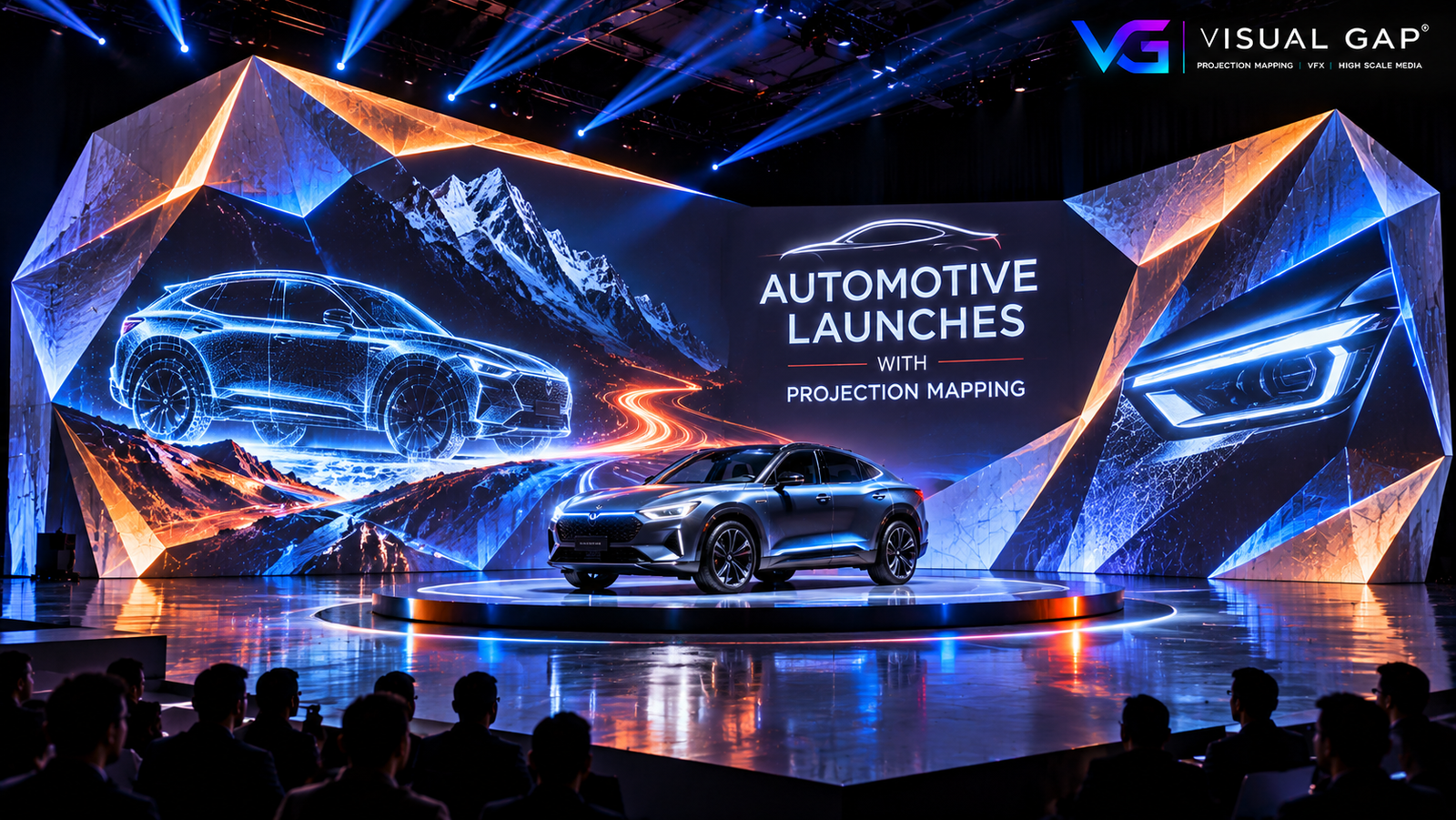
Projection mapping can turn the reveal into a coordinated sequence that combines visual storytelling, music, lighting, and stage production.
A typical creative concept might begin with a darkened stage and subtle animated graphics. Projected lines could gradually outline the vehicle’s shape before transitioning into detailed visuals that introduce its design language.
The sequence might conclude with the reveal of the actual vehicle as the stage lighting changes and the cover is removed.
Possible creative elements include:
Animated vehicle silhouettes.
Digital outlines highlighting exterior design.
Abstract visual effects inspired by the brand.
Motion graphics representing speed and performance.
Transitions inspired by the vehicle’s design features.
Coordinated lighting and audio cues.
The content should be developed around the vehicle’s actual dimensions and the intended viewing angles.
Because automotive surfaces are often curved, reflective, and irregular, projection mapping directly onto a car requires careful planning. In some situations, a projection-mapped stage or surrounding installation may produce a more reliable result than projecting onto the vehicle itself.
2. Projection Mapping on Vehicle Bodies
Projecting directly onto a vehicle can create a striking visual presentation when the surface, lighting, and projection setup are suitable.
Custom content can be designed to align with the car’s body panels, doors, bonnet, roof, and other visible features.
For example, a launch presentation could use animation to suggest how air moves around the vehicle, illustrate its design inspiration, or highlight selected exterior features.
Potential applications include:
Exterior design visualization: Use projected outlines and animations to draw attention to the vehicle’s shape.
Technology storytelling: Introduce selected features through visual sequences designed around the car.
Brand identity: Incorporate colours, graphics, and visual motifs associated with the manufacturer.
Concept vehicle presentations: Create experimental visual environments for concept cars and future mobility designs.
However, vehicle mapping has technical limitations. Glossy paint, chrome, glass, dark surfaces, and changing surface angles can affect image visibility. Projected colours may also appear differently across different materials.
Accurate 3D references, suitable projector positions, and content designed specifically for the vehicle are essential.
The technical team should test the setup under the actual event lighting conditions before the final presentation.
3. Projection Mapping for Electric Vehicle Launches
Electric vehicle launches often emphasize technology, sustainability, innovation, and the future of mobility.
Projection mapping can support these themes by creating visual sequences that communicate the product’s design and technological positioning.
For example, a presentation could introduce an electric vehicle through animated energy-inspired graphics, abstract electrical patterns, or visual storytelling about connected mobility.
Possible applications include:
Electric car unveilings.
Electric scooter and motorcycle launches.
Battery technology presentations.
Smart mobility exhibitions.
EV charging ecosystem demonstrations.
Future mobility concept showcases.
The visual narrative can also introduce selected vehicle features, such as charging capabilities or connected technology, when supported by accurate product information.
For technical subjects, content should remain clear and credible. Visual effects should help explain the product rather than make unsupported claims about its performance or environmental impact.
4. Projection Mapping for Automotive Stage Design
Automotive launch stages are often built around the vehicle as the central visual element.
Projection mapping can help transform suitable stage structures into dynamic environments that support the product presentation.
Instead of using a static stage backdrop, event designers can create visuals that change with each segment of the programme.
Applications include:
Vehicle launch opening sequences.
Brand history presentations.
New model introductions.
Technology demonstrations.
Executive presentations.
Dealer conferences and awards ceremonies.
A luxury vehicle launch might use understated architectural visuals, while a performance-oriented brand could choose energetic motion graphics.
Stage design should consider the audience’s sightlines, the vehicle’s visibility, and the balance between projected content and physical lighting.
If the event uses LED walls alongside projection mapping, the content should be designed as one coordinated visual system rather than a collection of unrelated displays.
5. Creating 3D Visual Effects for Automotive Launches
Three-dimensional animation can help explain vehicle design and engineering concepts that are difficult to communicate through conventional stage presentations.
A launch sequence could transition from a real vehicle into an animated visualization of its internal components, followed by a return to the physical product.
Potential content includes:
Exploded-view animations of selected components.
Visual explanations of vehicle design.
Engine or electric motor demonstrations.
Battery architecture visualizations.
Aerodynamic concepts.
Chassis and suspension illustrations.
Digital representations of connected vehicle systems.
These animations can be projected onto a suitable surface, integrated into a larger stage environment, or combined with vehicle projection mapping.
It is important to distinguish between actual projection mapping and other display techniques. A 3D animation shown on a conventional LED screen is not automatically projection mapping, even if it creates an impressive visual illusion.
For a projection-mapped reveal, the content must be designed around the physical surface or environment being projected onto.
6. Projection Mapping for Automotive Exhibitions and Motor Shows
Automotive exhibitions and motor shows provide opportunities for manufacturers to present multiple vehicles, technologies, and brand experiences within a limited space.
Projection mapping can help exhibitors develop distinctive installations that attract attention and communicate product information.
Possible applications include:
Vehicle display installations.
Concept car presentations.
Brand heritage showcases.
Interactive product experiences.
Technology demonstrations.
Special event presentations within exhibition spaces.
A projection-mapped installation can also support a narrative connecting a manufacturer’s history with its future product strategy.
For example, a brand could use an architectural installation to introduce its design philosophy before transitioning to visuals related to a new vehicle range.
Exhibition environments often have high ambient lighting and substantial visual competition. Projector brightness, projection surface selection, content contrast, and visitor viewing distance should therefore be evaluated carefully.
For some displays, an LED wall may be more suitable. Projection mapping is particularly valuable when the installation benefits from transforming physical objects or architectural structures.
7. Projection Mapping vs LED Walls for Car Launches
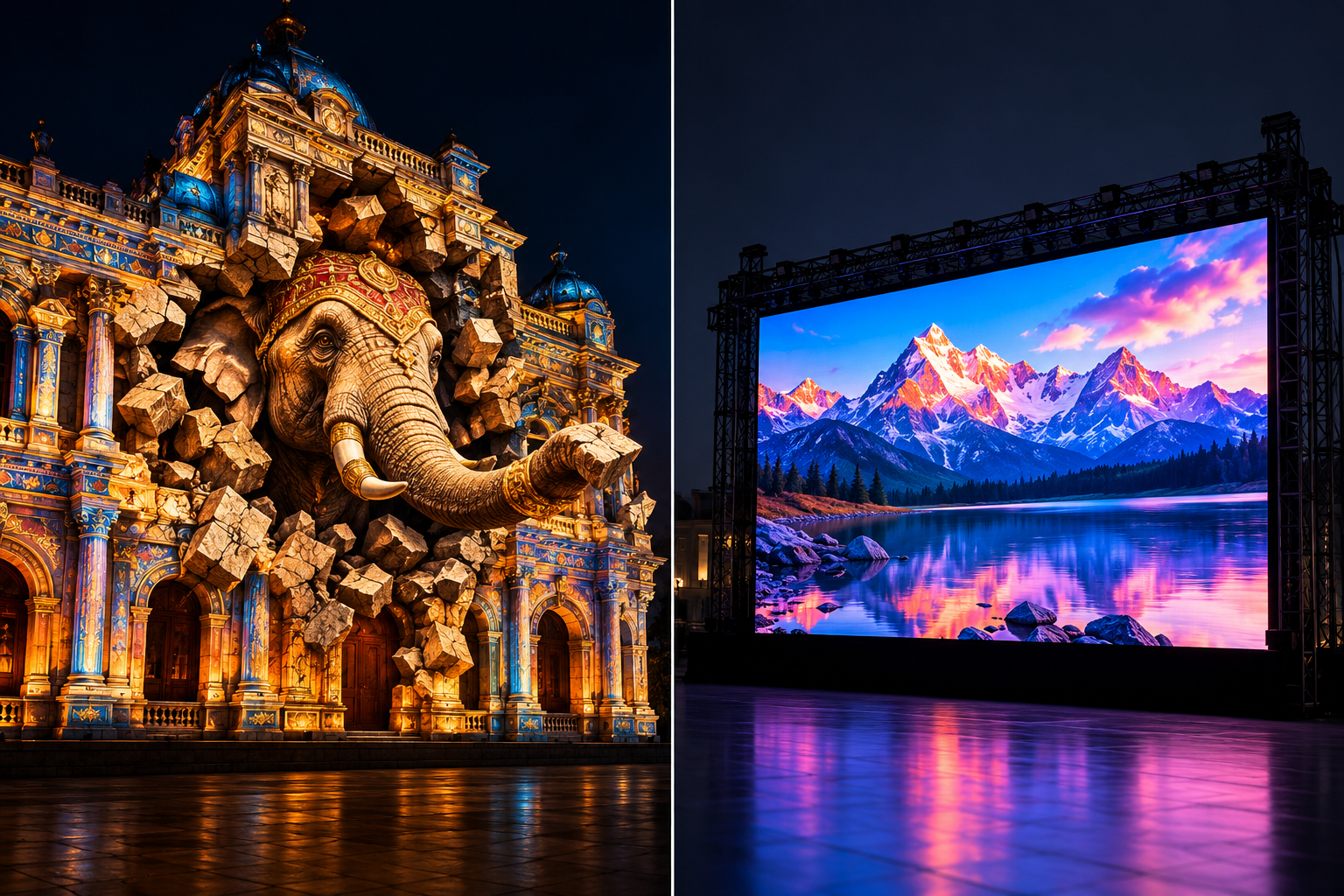
Both projection mapping and LED displays are widely used in automotive events, but their strengths differ.
| Feature | Projection Mapping | LED Walls |
|---|---|---|
| Main use | Transforming suitable physical surfaces and objects | Displaying digital content on dedicated panels |
| Vehicle integration | Can be designed around the vehicle’s geometry | Usually displays content separately from the vehicle |
| Creative possibilities | Can create object-based and architectural visual effects | Supports high-resolution video, graphics, and presentations |
| Bright environments | Performance depends on ambient light and surface conditions | Generally performs well in bright event environments |
| Installation | Requires projector placement, mapping, and calibration | Requires panels, mounting, power, and control systems |
| Content requirements | May require geometry-specific content | Usually designed for the display canvas |
| Best applications | Vehicle mapping, immersive stage effects, architectural transformation | Product information, presentations, live video, and high-brightness visuals |
The best choice depends on the venue, creative objective, available budget, and desired audience experience.
In many automotive launches, a hybrid approach works well: LED walls provide readable product information and video content, while projection mapping transforms the vehicle or surrounding stage into a distinctive visual attraction.
For a broader comparison, read Visual GAP’s Projection Mapping vs LED Wall guide.
8. How Much Does Projection Mapping for Automotive Launches Cost?
The cost of an automotive projection mapping installation depends on the complexity of the concept, the number of projectors, the physical surfaces involved, and the amount of custom content required.
A simple projection-mapped stage element may require a relatively straightforward setup, while a large vehicle launch involving multiple projectors, custom animation, and synchronized show control will require more extensive production.
Major cost factors include:
Number and brightness of projectors.
Vehicle dimensions and surface geometry.
Stage structure and projection area.
Custom 2D and 3D content production.
Projection mapping and calibration.
Media servers and playback systems.
Rigging, mounting, and cabling.
Lighting and audio synchronization.
Technical rehearsals and on-site operation.
Transport, installation time, and event duration.
Content production can be a major part of the budget, especially when animation must be designed around a specific vehicle or stage structure.
Automotive brands should also account for technical rehearsals, because the final result depends on precise alignment and synchronization.
For an accurate estimate, provide the event date, venue, vehicle dimensions, stage design, content requirements, and technical specifications.
You can review Visual GAP’s Projection Mapping Costs guide for additional budgeting considerations.
9. How to Plan a Successful Automotive Projection Mapping Event
A successful automotive launch requires close coordination between creative production, technical design, brand teams, and event management.
Define the Product Story
Identify the most important messages to communicate, such as vehicle design, innovation, performance, or brand heritage.
Survey the Venue
Assess the venue dimensions, ambient lighting, ceiling height, projector positions, power availability, and audience viewing angles.
Measure the Vehicle and Stage
If projecting onto the vehicle, obtain accurate references and assess the surface geometry. If using a stage structure, document its dimensions and materials before content production.
Develop Custom Content
Create animation and motion graphics around the actual projection surface and launch narrative. Product information should be reviewed for accuracy by the brand team.
Plan Technical Integration
Coordinate projectors, playback systems, mapping software, audio, lighting, and stage management.
Rehearse the Reveal
Test the complete sequence, including visual transitions, music, lighting cues, and the physical vehicle reveal.
Prepare Contingency Plans
Have a backup playback strategy and establish clear responsibilities for technical issues during the event.
Conclusion
Projection mapping for automotive launches creates opportunities to present vehicles through immersive visual storytelling, custom animation, and coordinated stage production.
From luxury car reveals and electric vehicle launches to motor shows and automotive exhibitions, projection mapping can transform suitable vehicles and physical environments into distinctive brand experiences.
Successful installations require accurate measurements, carefully produced content, appropriate projection technology, and thorough rehearsals.
For automotive brands and event production companies, the technology can be a valuable creative tool when its visual impact supports the product story and the goals of the launch.
Visual GAP develops projection mapping and immersive visual experiences for product launches, architectural environments, exhibitions, museums, and branded events. By combining technical planning with creative storytelling, Visual GAP helps bring ambitious visual concepts to life.